
Customise your approach
- Tailor your schedule: Use the toolkit’s modular design to structure sessions that fit your team’s time commitments, whether that’s a quick strategy meeting or an intensive multi-day workshop.
- Choose your format: The content is suitable for both face-to-face and virtual settings. You can work through the materials as a group, in smaller breakout sessions, or individually before reconvening to share insights.
Build around your objectives
- Define your goals: Start by setting clear objectives for your session. Whether you’re refining a current strategy or building a new Theory of Change from scratch, the toolkit’s resources guide you through every step.
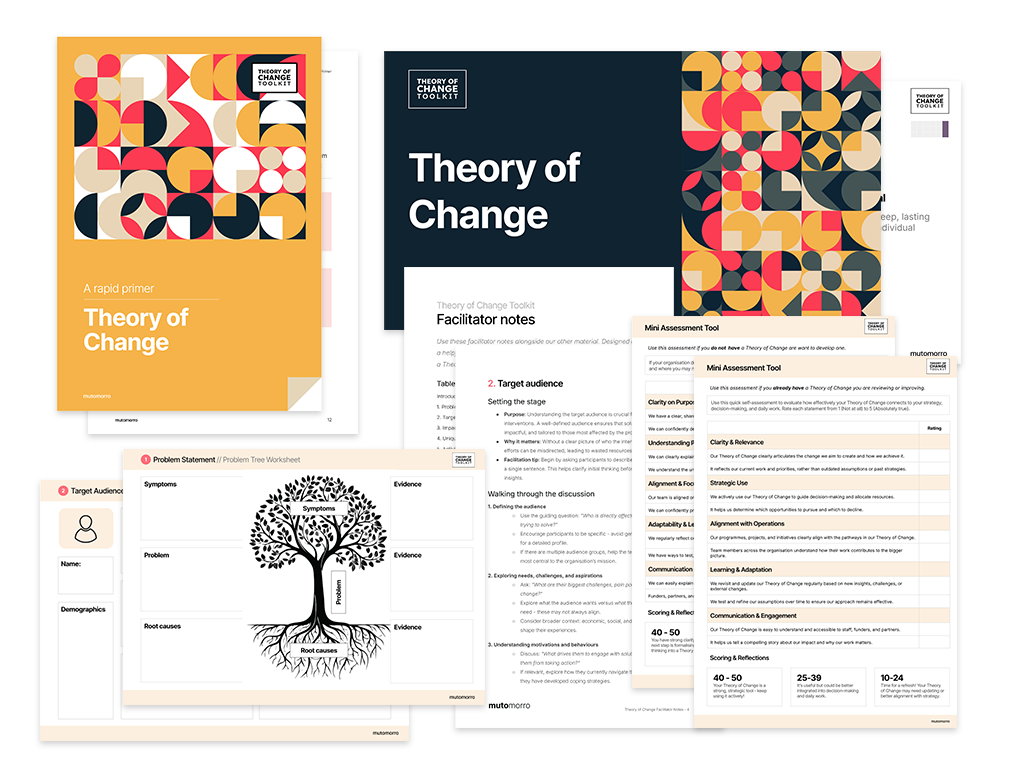
- Use the provided tools: From mini assessments and worksheets to the slide deck and facilitator notes, each component is designed to help you capture ideas, spark discussion, and evaluate progress in real time.
Preparation and planning
- Familiarise your team with the toolkit’s structure and set expectations.
- Pre-read the Rapid Primer to ensure everyone understands the foundational concepts.
Interactive sessions
- Begin with a collaborative session to discuss the overall framework and establish a shared vision.
- Use mini assessments and worksheets to delve into specific areas such as defining the problem statement or outlining short-term outcomes.
- Leverage the slide deck as a visual guide, ensuring that all team members are aligned and informed.
Facilitation and collaboration
- Rely on the facilitator notes to guide discussions, keeping sessions focused and productive.
- Encourage open dialogue by using the Miro board blueprint to capture ideas and collaboratively refine your Theory of Change.
Customisation and follow-up
- Adapt the toolkit’s materials (all available as Word, PowerPoint, and Miro templates) to reflect your organisation’s unique branding and requirements.
- Schedule follow-up sessions to review progress, refine strategies, and ensure the Theory of Change remains a living document that evolves with your organisation.

